
Catherine Kirana Sutiono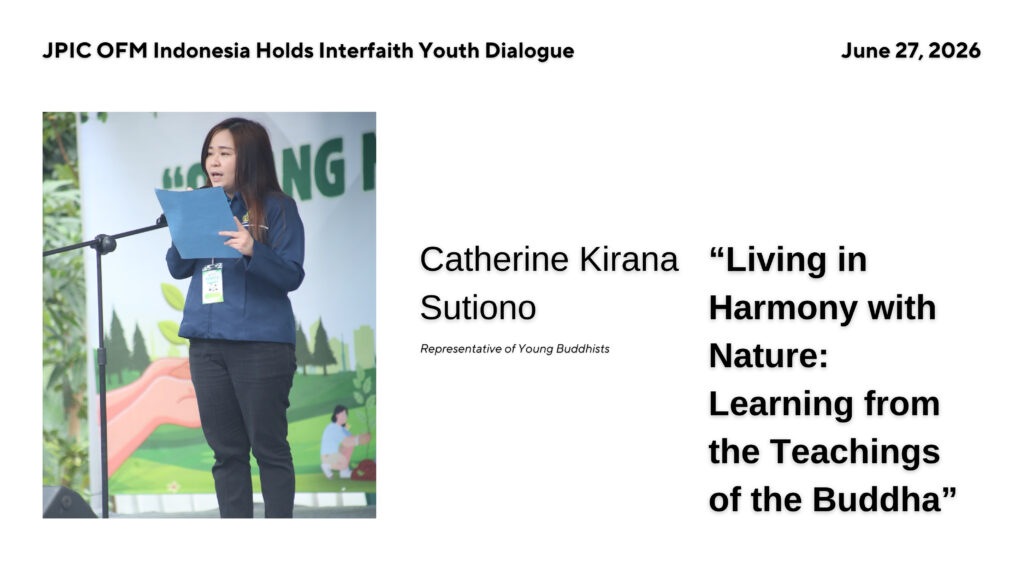
On this blessed and meaningful occasion, let us take a moment to reflect on the reality around us. Today, news about water and air pollution, deforestation, climate change, and oceans filled with plastic waste is no longer unfamiliar. These environmental issues are not simply a matter of public policy, politics, or development.
Allow me to offer a Buddhist perspective on this matter: the environmental crisis is fundamentally a reflection of humanity’s inner crisis. When greed (lobha), hatred (dosa), and ignorance (moha) dominate the mind, humans will tend to exploit nature without limit. Conversely, when wisdom and awareness develop, we will live in harmony with nature.
Buddha taught the universal law of interdependence, stating that no creature or material in this world can exist alone. Our lives as humans depend entirely on clean water, fertile soil, healthy air, and sustainable forests. When we damage these natural conditions, suffering not only affects nature itself but also flows back to us and future generations.
Furthermore, in one of his sermons, the Buddha gave a beautiful parable about bees. Just as bees gather honey from flowers without destroying their color and fragrance, so too should we seek a livelihood and utilize natural resources. We are full of needs, but we are taught to take just enough, cultivate contentment (santutthi), and maintain the sustainability of these lifeblood sources. Buddhist monks uphold the principle of sufficiency in life, allowing them to have only one spare robe and refrain from hoarding excessively. True development is not one that depletes nature, but one that maintains balance.
This attitude also embodies the boundless mettā (loving-kindness) and karuṇā (compassion), as outlined in the Discourse on Loving-Kindness. When forests are cut down and rivers are polluted, animals lose their homes and plants slowly die. Protecting the environment is our way of radiating love to all beings—both great and small, visible and invisible—so that they may continue to be happy and safe. Furthermore, the Buddha also warned against greed in managing resources, which in turn leads to poverty and social conflict. He emphasized that environmental protection and social justice must go hand in hand.
Since the Buddha’s time, environmental awareness is nothing new; this moral discipline has been deeply embedded in the rules that monks must follow. The Vinaya Pitaka (Monastic Code) records a rule called Pacittiya, which strictly forbids monks from harming plants and polluting water. When monks’ robes become worn or damaged, they are required to mend them, reusing them as bed sheets, window curtains, and even doormats. The principles of Reduce, Reuse, and Recycle were instilled by the Buddha thousands of years ago. This demonstrates that caring for nature is an integral part of Buddhist moral training (sila).
Therefore, let us use this momentum to transform our daily behavior into concrete Dhamma practices. Start with small things in our own homes: wisely using water and energy, planting trees, reducing waste, and limiting the use of single-use plastics. Controlling material desires and living modestly are concrete forms of our care for this earth. Furthermore, religious institutions should also continue to work together to preserve the earth’s sustainability through concrete actions like those being undertaken today.
Let us cultivate a mind full of awareness and responsibility for a more peaceful and sustainable future for the earth.
Sabbe sattā bhavantu sukhitattā.
May all beings be happy.
Sādhu, sādhu, sādhu.