Ellen Gloria Ayu Permata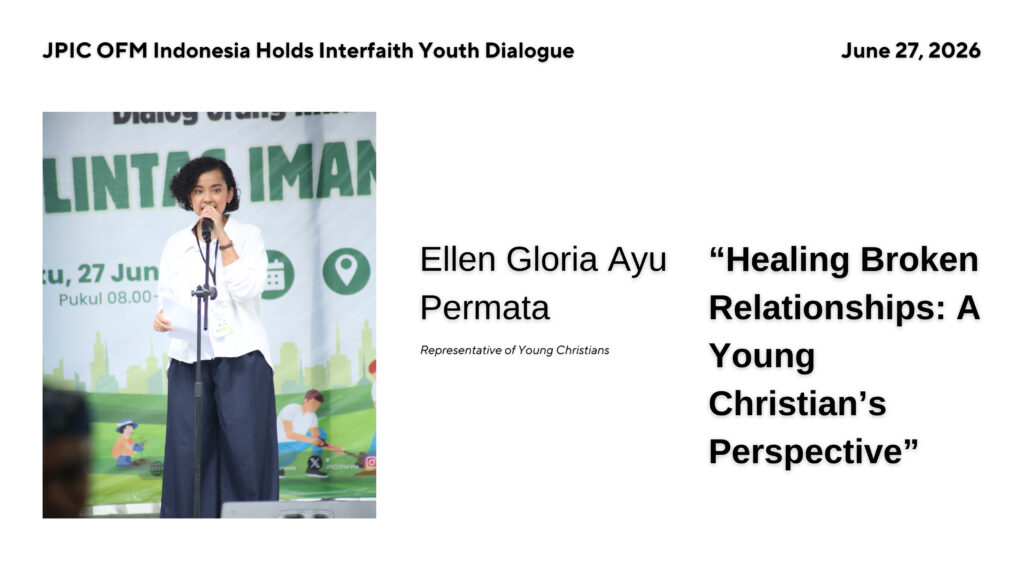
My dear friends, today I stand before you as a fellow human being and as a fellow inhabitant of the only home we have – our Earth.
This morning, I’d like to invite you all to reflect on and take a fresh look at what’s happening on Earth and in our country. Global temperatures for the 2011–2020 period were recorded at approximately +1.09°C higher than the pre-industrial period of 1850–1900; flash floods have swept away forests and eroded the land; and sea-level rise in Indonesian waters has been recorded as faster than the global average, reaching 3–10 mm per year in various regions.
These figures are indeed crucial as indicators of the climate and ecological crisis we face and are a result of other, more fundamental failures and damage.
The Failure of Political and Economic Policies
The climate and ecological crisis we are currently experiencing is the result of flawed design and the bitter fruit of the failure of our political policies and economic system.
We are forced to live within an economic system that idolizes unlimited growth, on our finite planet. Today’s economy operates by extracting, producing, consuming, and then discarding. We treat the Earth not as a home that must be cared for, but as a money-printing machine and a seemingly inexhaustible warehouse of resources.
This economic system is further exacerbated by political policies that often serve as a red carpet for environmental destroyers. In the name of investment figures and the pretext of “development”, environmental impact assessments (EIA) are often reduced to mere formalities on paper. Regulations are relaxed, and the voices of indigenous peoples and local communities—whose living spaces have been seized—are simply silenced.
When policies and regulations benefit only a handful of elites or privileged groups, social inequality ensues. These elites can rake in trillions of rupiah from the exploitation of nature, while we and our fellow citizens are left to bear the waste, the flash floods, and the droughts. This failure not only destroys our environment and living spaces but also erodes our sense of humanity and creates a crisis in our relationships with one another.
The Crisis of Relationships
The Crisis in the Relationship Between Humans and Nature
A system that glorifies exploitation has distanced us from the earth beneath our feet. We have lost respect for the environment that provides us with air, water, and life. We view nature merely as a “commodity”—an inanimate object that can be exploited at will—rather than as a living space that must be cared for.
The Crisis in Human Relations with One Another
The systemic failures of the economic and political systems mentioned earlier have also led to social inequality and damaged our relationships with one another. We have lost empathy for the suffering of our fellow human beings. Take, for example, the floods in Sumatra. Many of us, as fellow citizens, empathized and worked together to help those affected. But it turns out not everyone did. Many stakeholders have not fully shown solidarity or empathy to expedite aid and the reconstruction of flood-affected areas in Sumatra.
The Crisis in the Relationship Between Humans and God
And ultimately, we have forgotten that this universe does not belong to us. The Earth is a creation—a trust entrusted to us by the Almighty to be preserved and cared for–not destroyed.
When we trample on His creation for the sake of economic greed or power, we are in fact defiling that trust. We have acted arrogantly. This ecological crisis is, in essence, a spiritual crisis—clear evidence that a greedy system has made us lose sight of ourselves and forget the Creator.
Call to Action: Ecological Conversion and a Fair Way of Thinking to Address the Crisis of Relationships
Faced with the collapse of the system and the aforementioned crisis of relationships, we need a transformation of consciousness, a fair way of thinking, and ecological conversion.
A fair way of thinking means we stop positioning ourselves above our fellow human beings and stop thinking that we are free to exploit nature as a commodity. Let us once again realize that we are merely a small node in the web of life.
Furthermore, the Ecological Conversion taught by Pope Francis in Laudato Si’ can also be applied to restore the three fractured relationships mentioned earlier: First, restoring our relationship with God. Let’s make caring for the environment a part of our daily worship. Realize that simple actions like sorting trash, conserving energy, or caring for the environment are expressions of gratitude. Preserving nature is a form of respect and obedience to the Creator who has entrusted this earth to us.
Second, restoring our relationship with nature. This repentance must begin with our lifestyle. Let’s have the courage to go against the tide of consumerist culture. Let’s “slow down” our dependence on single-use plastics and get into the habit of living modestly. Remember, the earth has enough resources to sustain all our needs, but it will never be able to satisfy human greed.
Third, restoring our relationship with our fellow human beings. Let’s use our purchasing power and our voices fairly. We can empower local economies around us. More than that, let’s make our social media a voice for justice. Amplify the cries of indigenous communities whose living spaces are being seized in the name of development. Keep a close watch on every policy that has the potential to destroy our future.
Because, in truth, great change can arise from the courage of young people who embrace ecological repentance, dare to take a stand, and persistently fight for justice.
Let’s restore our relationships and care for the Earth as our home—the only place we can return to. ***