Br. Yohanes Wahyu Prasetyo OFM
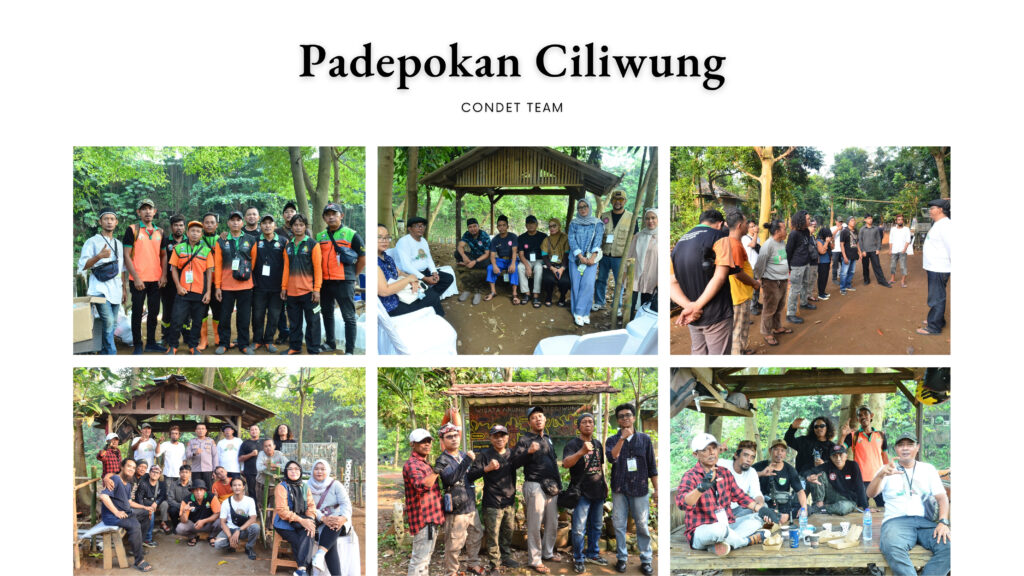
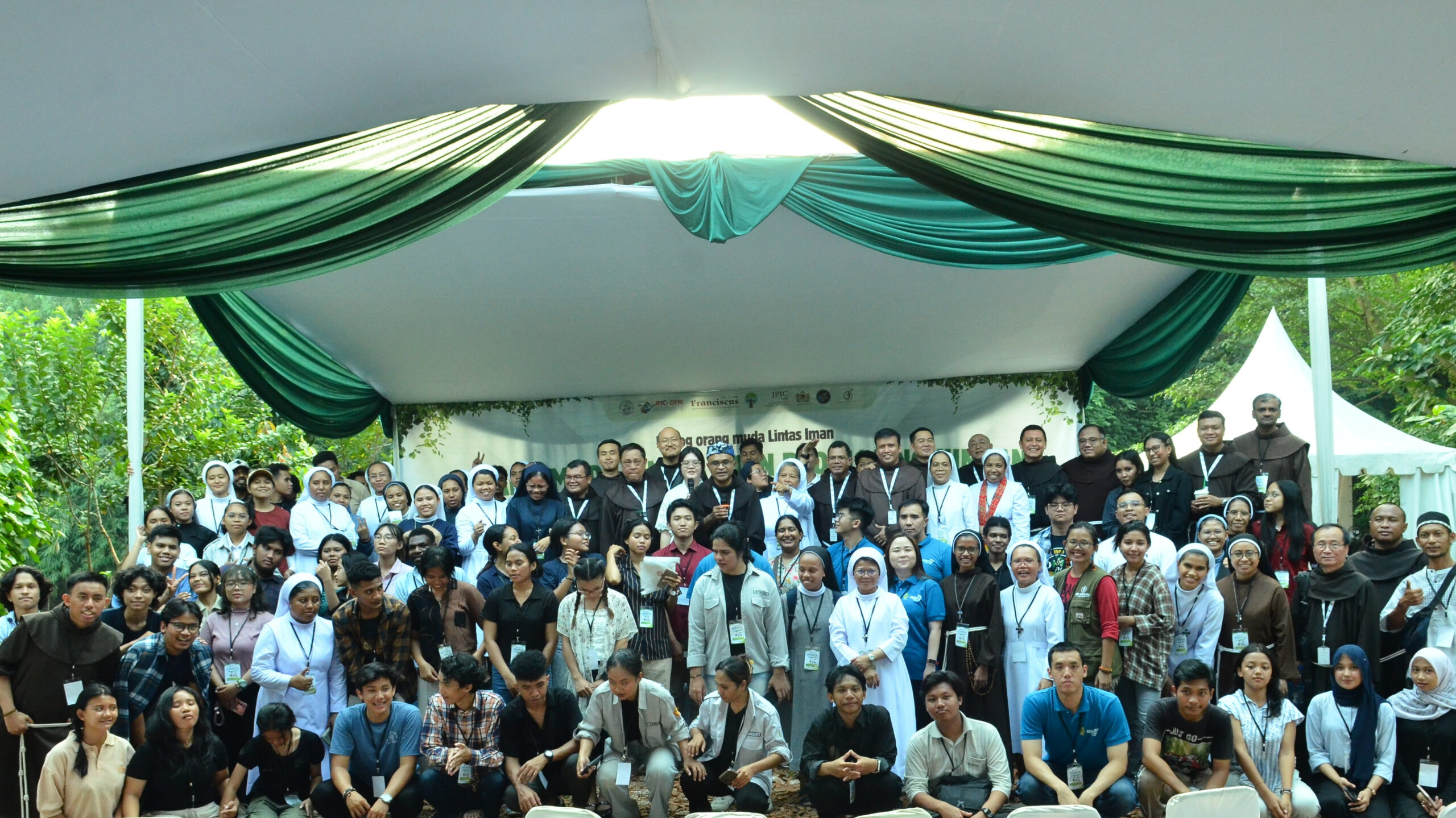
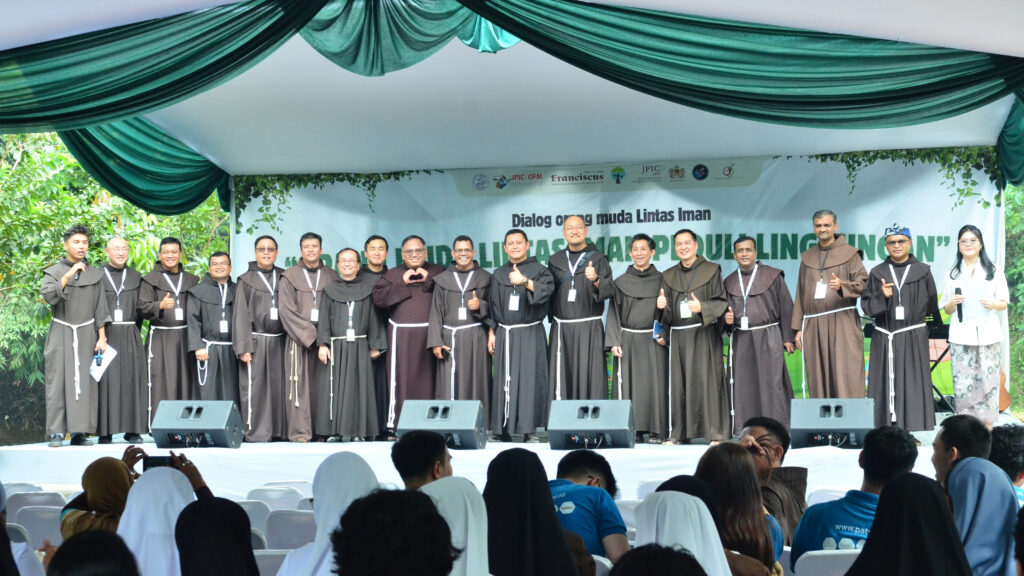
In order to (1) celebrate the 800th Anniversary of the Death of St. Francis of Assisi, (2) closing of the JPIC OFM Continental Meeting Asia-Oceania 2026, and (3) following up on the Interfaith Youth Dialogue activity on May 24, 2025 at the Vitra Ballroom – Jakarta, JPIC OFM Indonesia held an Interfaith Youth Dialogue at the Padepokan Ciliwung Condet on Saturday, June 27, 2026 at 08.00-17.00 with the theme Interfaith Youth Care for the Environment which was attended by 200 interfaith young people, participants of the JPIC OFM Continental Meeting Asia-Oceania 2026 [General JPIC Office, JPIC OFM Indonesia, JPIC OFM Malaysia-Singapore, JPIC OFM Vietnam, JPIC OFM Sri Lanka, JPIC OFM Australia-New Zealand, JPIC OFM India, JPIC OFM Philippines, JPIC OFM Hong Kong, JPIC OFM Korea, JPIC OFM Timor Leste, JPIC OFM Japan, JPIC OFM Myanmar, JPIC OFM Papua, Franciscans International, and the President of the East Asian Conference], OFM Young Brothers, and Franciscan Sisters [FSGM, OSF Semarang, FCh, SFS, SFIC, FSE, HSHJ, and MCFSM].
The interfaith youth dialogue activities are arranged in the following program. (1) Registration. Participants who are present fill out the attendance list, then they enjoy food and drinks while enjoying the songs Laudato si’, o mi Signore, Make Me a Channel of Your Peace, etc.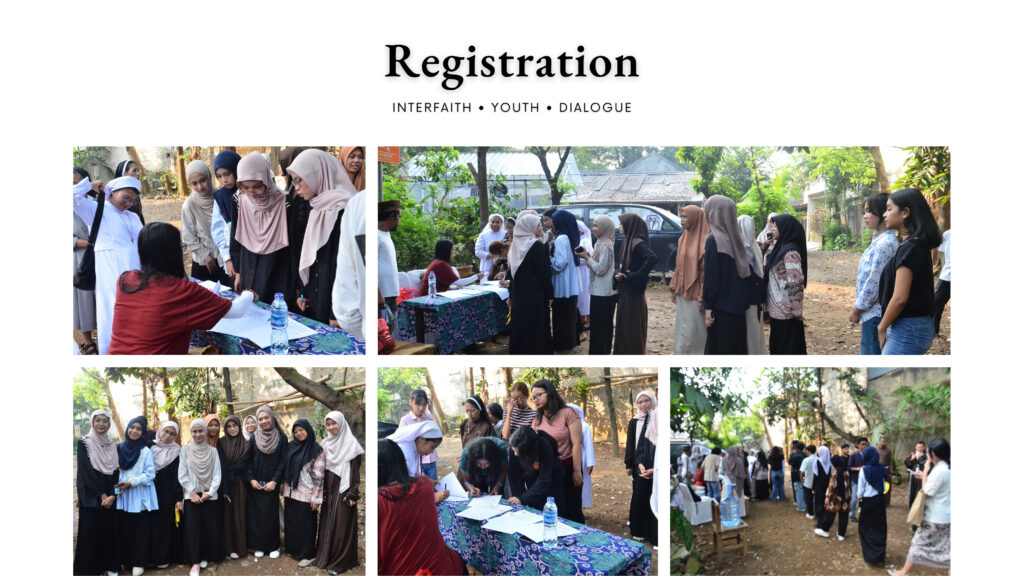
(2) Opening. The MC greeted the participants who were present and gathered at the event venue and continued with a speech delivered by Br. Yohanes Wahyu Prasetyo OFM as the chairman of the interfaith youth dialogue committee. Then, to officially open the interfaith youth dialogue activity, it was marked by the release of sparrows by the participants of the JPIC OFM Continental Meeting Asia-Oceania 2026. Next, before moving on to the next event, the OFM Young Brothers entertained the interfaith youth dialogue participants by singing a number of songs.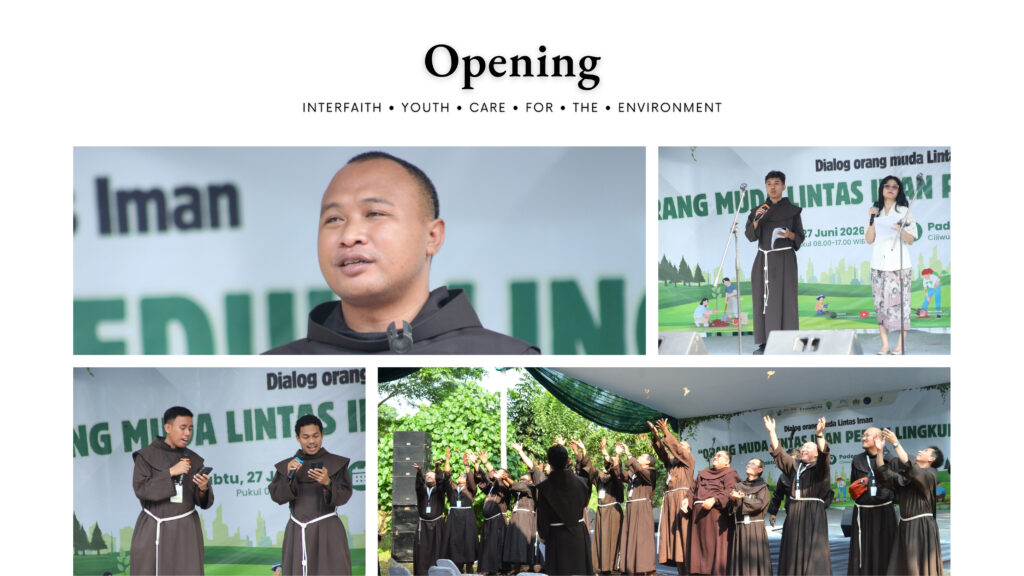
(3) Speeches by representatives of young people from six religions [Catholic, Christian, Islam, Hindu, Buddhist, and Confucian]. First, Nikita Virya Atmadja [representative of young Confucians] delivered a speech on the theme “Young People Care for the Environment from a Confucian Perspective”. Second, Ellen Gloria Ayu Permata [representative of young Christians] delivered a speech on the theme “Healing Broken Relationships: A Young Christian’s Perspective”. Third, Alya Nafilah Maulana [representative of young Muslims] delivered a speech on the theme “Young Muslims Care About the Environment”. Fourth, Liana Tirta Sari [representative of young Hindus] delivered a speech on the theme “Young Hindus Care About the Environment: Learning from Tri Hita Karana and Dharma”. Fifth, Catherine Kirana Sutiono [representative of young Buddhists] delivered a speech on the theme “Living in Harmony with Nature: Learning from the Teachings of the Buddha”. Sixth, Maria Patrisia Widi Astuty Manjur (representative of young Catholics) delivered a speech on the theme “Young Catholics Perspectives on the Ecological Crisis”. Before and after the speeches by the youth representatives (Catholic, Christian, Islam, Hindu, Buddhist, and Confucian), there were displays of events prepared and presented by young people from the six religions.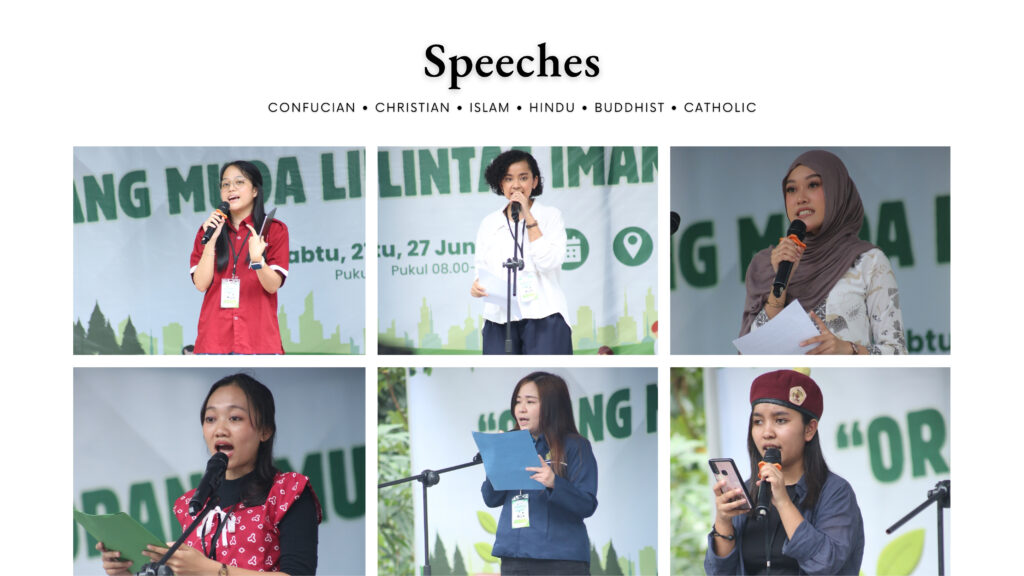
(4) Ecological prayer and blessing of the statue of St. Francis of Assisi, tree seeds, and fish seeds. The ecological prayer was led by Br. Aloysius Gonzaga Goa Wonga OFM and accompanied by Lino Gregorio V. Redoblado OFM and Taucen Hotlan Girsang OFM. In the ecological prayer, prayers of supplication were delivered by representatives of young people from Catholic, Christian, Islam, Hindu, Buddhist, and Confucian.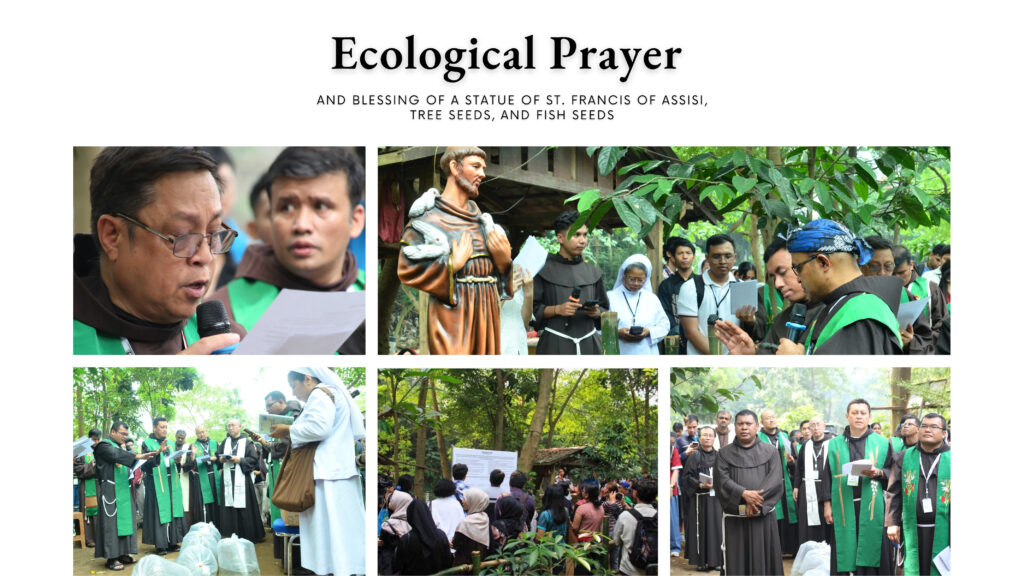
(5) Reading of the earth charter and signing of the charter by participants of the JPIC OFM Continental Meeting Asia-Oceania 2026 [Br. Ignacio Ceja Jiménez OFM, Br. Lino Gregorio V. Redoblado OFM, Br. Daniel Rodríguez Blanco OFM, Br. Taucen Hotlan Girsang OFM, Br. Aloysius Gonzaga Goa Wonga OFM, Br. Cosmas Francis OFM, Br. Joseph Vu Lien Minh OFM, Br. Kuranage Pattrick Sujeewa Perera OFM, Br. Adrianus Nahal OFM, Br. Simon A. OFM, Br. Orly Barro Jimeno OFM, Br. Angelito Andig Cortez OFM, Br. Raymond Mary Yim Yeung OFM, Br. Michael Yang OFM, Br. Abril Dos Santos OFM, Br. Peter Abe Keita OFM, Br. Augustine Seng Mun Aung OFM, Br. Alexandro Farini Rangga OFM, and Budi Tjahjono] and representatives from Padepokan Ciliwung Condet [Ahmad Maulana].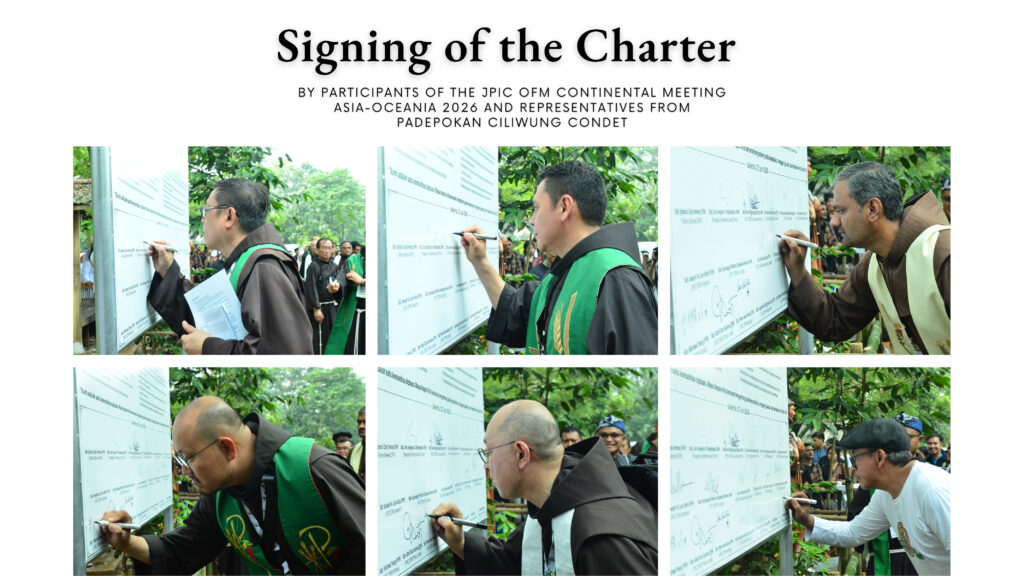
(6) Planting tree seeds accompanied by Hadroh music. Hadroh music is played by nine young people who live around the Padepokan Ciliwung Condet.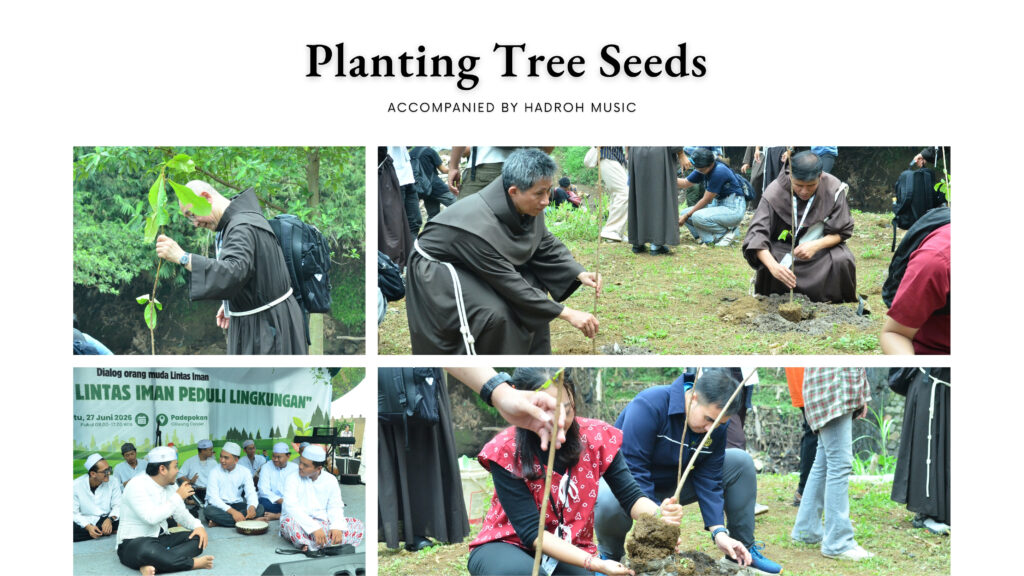
(7) Lunch and group discussion. Participants were divided into six groups, enjoyed lunch, introduced themselves, and had a discussion. There were six questions discussed in the groups. First, what ecological crisis is occurring in Indonesia or in your surroundings? Second, why is this ecological crisis occurring (social, economic, political, cultural, educational, technological, public policy factors, etc.)? Third, to what extent are the roles of the government, religion, and society in dealing with the ecological crisis? Fourth, what have you done to care for the earth as our shared home? Fifth, what is your commitment as young people (young people of different faiths) in dealing with the ecological crisis? Sixth, what message do you want to convey to the government, religious leaders, and society regarding the phenomenon of the ecological crisis?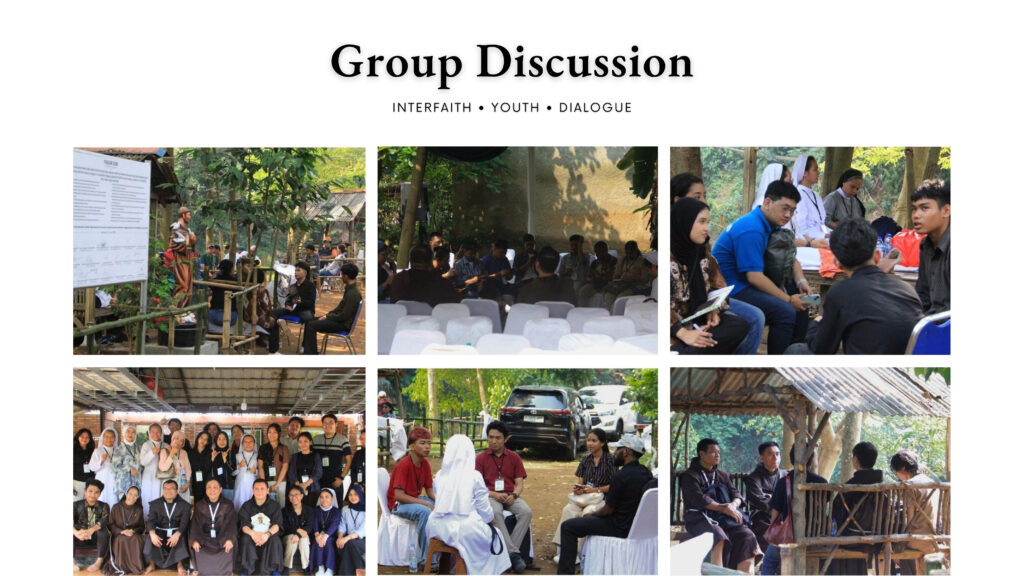
(8) Traversing the river and spreading fish seeds. Participants of the JPIC OFM Continental Meeting Asia-Oceania 2026 traversed the Ciliwung River using rubber boats and spread fish seeds.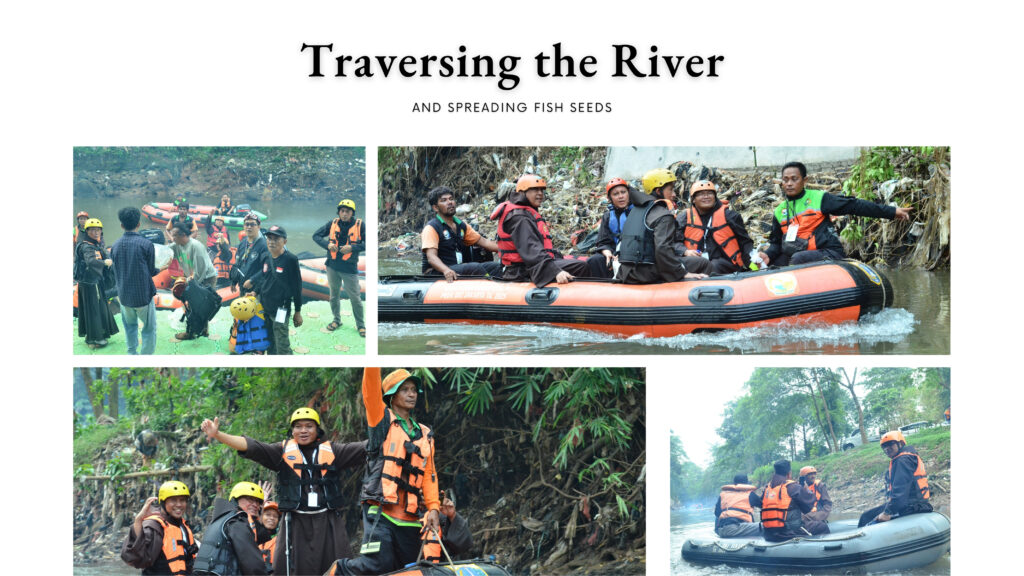
(9) Presentation of the results of group discussions delivered by six group leaders. First, Khoirotun Nisak, the leader of group one, presented the results of the group discussion as follows. [a] Economic factors cause the community to accept environmental projects that damage nature. In this regard, strategic projects disrupt the culture of the community which can naturally create local food security in the region. It should be noted that damage to natural ecosystems is caused by mining waste, industrial waste, etc. In addition, there is a lack of education for the community on how to manage and cultivate land and natural resources in each region. [b] Factors that cause the ecological crisis are economic, political, and educational factors. Meanwhile, social factors and public policy are the domino effect of economic, political, and educational factors. [c] The ecological crisis has only become a jargon in various organizations, NGOs, and the government. This is a criticism of various activities that raise the issues of environmental crisis, nature conservation, climate change, etc. In fact, these issues are also included in magazines, newspapers, and other media. However, it is only a jargon that is echoed and is not accompanied by concrete steps. Therefore, a massive and collaborative movement is needed, for example collaboration between faiths, between organizations, between governments, etc. In this regard, the government’s role is still at the level of capitalist and business logic. [d] Simple actions that young people have taken to resolve the ecological crisis include carrying water bottles, sorting waste, planting trees, and protecting their respective lands in the face of the uncertainty of agrarian law. [e] Our commitment as young people is to not be apathetic towards environmental issues, not to be hypocritical or image-building in the environmental movement, and to maintain the balance of nature. [f] The government must repent, open its eyes, ears, and heart to the suffering of the people, and not close itself to criticism. Meanwhile, religious leaders must realize that their role is very large and influential on the wider community – everything they say and do is an example. Finally, the community must learn, increase accurate literacy and not be fooled by hoaxes. Realize that there is no harm in protecting the environment – this is a major investment for future generations and must not be afraid to provide criticism.
Second, Demmy Aria Sutjipto, the leader of group two, presented the results of the group discussion as follows. [a] Currently, deforestation and deforestation are occurring in connection with the development of housing projects and the manufacturing industry. Furthermore, poor waste management, for example, results in blockages that impede water flow and cause flooding. There is also the habit of throwing plastic carelessly or in inappropriate places. We are also experiencing climate change, where the air temperature is getting hotter. [b] The ecological crisis occurs due to environmental indifference, a lack of education and awareness of environmental protection. It is important to understand that whatever we do to the environment will have an impact on each of us. Furthermore, government policies do not consider long-term impacts and tend to exploit nature. [c] Government policies regarding mining are seriously damaging the environmental network. In the short term, mining is considered very profitable economically, but they forget that in the long term, mining damages the environment. Therefore, efforts are needed for ecological repentance, awareness and concern for the environment. [d] What young people have done is using public transportation, carrying shopping bags, collecting household waste for composting, conserving electricity, and planting trees. [e] We are committed to preserving the environment – hoping to leave a sustainable environment for future generations. We also campaign to protect the earth, our shared home. [f] When the government makes policies, for example regarding national strategic projects, it must consider the long-term environmental impacts, especially those related to environmental sustainability. Religious leaders need to promote the 3Rs (reuse, reduce, and recycle) in their respective places of prayer.
Third, Anggun Julia, the leader of group three, presented the results of the group discussion as follows. [a] The ecological crisis is not only an environmental issue, but also relates to social, economic, political, cultural, and moral responsibilities as human beings. It is important to note that Indonesia is facing various ecological crises, namely flooding, river pollution due to household waste, industrial waste, and the loss of biodiversity. In addition, large-scale development, such as national strategic projects, the development of food estate projects, mining activities with large-scale forest clearing that result in deforestation, land grabbing and the loss of community rights to land and natural resources. Thus, the ecological crisis is a global issue that requires our attention. [b] Government policies that are oriented towards economic growth rather than environmental sustainability. Exploitation of nature carried out by large companies, especially in the mining and plantation sectors, which often ignore the environmental impact. Weak supervision and law enforcement, so that many environmental violations are still not firmly prosecuted. Low public awareness of the importance of protecting the environment, for example, throwing garbage in rivers, excessive use of single-use plastics, and not managing waste properly. [c] The government has the responsibility to create policies that support the environment, monitor, and impose sanctions on those who damage the environment. Religious leaders and religious institutions also play an important role. All religions teach the importance of protecting the environment and living in harmony with all living things. The public has a significant responsibility through concrete actions, such as managing waste within the household and participating in monitoring government policies. [d] Reduce the use of single-use plastics, carry shopping bags, sort waste, conserve electricity and water, plant trees, care for plants around the house, and participate in activities related to ecology. [e] Dare to improve and evaluate yourself, dare to reprimand others when throwing waste carelessly or inappropriately, sort waste, conserve electricity, water, and natural resources, and encourage the public to care for the environment by utilizing social media. [f] It is hoped that the government will continue to pay attention to environmental sustainability and public welfare when making policies. In addition, law enforcement against perpetrators of environmental damage needs to be carried out fairly and firmly. Meanwhile, religious leaders must continue to teach the value of caring for nature, where protecting the environment is part of worship. Finally, society must start change from within and evaluate itself. Because the earth is our shared home, let us move together to leave a healthy, green, and sustainable earth to future generations.
Fourth, Yohanes Januar Agus, the leader of group four, presented the results of the group discussion as follows. [a] There are a number of ecological crises occurring, namely the mining industry, cloudy river water due to mining waste disposal, deforestation for palm oil plantations, lack of oxygen due to deforestation, polluted air due to extreme pollution, flooding, and unmanaged waste. [b] The ecological crisis occurs due to weak awareness of environmental care and no concern for reminding each other about maintaining a clean lifestyle. [c] The government holds control of large-scale regulations and policies regarding the safety of the earth. The role of religion is to build spiritual awareness, environmental ethics, seeing nature not as an object of exploitation, and the sacredness of nature. The role of society is to ensure the realization of the 3R principle (reuse, reduce, and recycle). [d] What we have done as young people is a clean lifestyle, reducing the use of disposable items, and not littering. [e] We are committed to inviting others to love nature, reduce the use of disposable plastic, sort waste, and use public transportation. [f] The government must pay attention to and ensure that development does not sacrifice environmental sustainability and community rights, protecting nature as part of our moral and spiritual responsibility to God and fellow living creatures, and protecting forests and the earth. Meanwhile, religious leaders must understand that the earth is not just a place of worship and the importance of sermons on environmental preservation accompanied by concrete examples. Finally, for the community – hope must be accompanied by concrete change.
Fifth, Adjie Valeria, the leader of group five, presented the results of the group discussion as follows. The ecological crises that have occurred include air pollution, river and sea pollution, deforestation for palm oil plantations, climate change, and air pollution. So far, the government’s role has been less than optimal in ensuring environmental preservation. Meanwhile, the community has made considerable efforts to care for the environment in their own ways, such as planting trees, protecting animal habitats, and instilling a love of the environment through literacy. Finally, it is important to maintain environmental cleanliness, reduce plastic waste, sort waste, and use public transportation.
Sixth, Nur Aura Nabila Akbaria, the leader of group six, presented the results of the group discussion as follows: Various ecological crises are currently occurring, such as tree felling, etc. Concrete actions we can take include collecting waste and recycling. Furthermore, it is important to reflect on every action that damages nature and to engage in ecological repentance.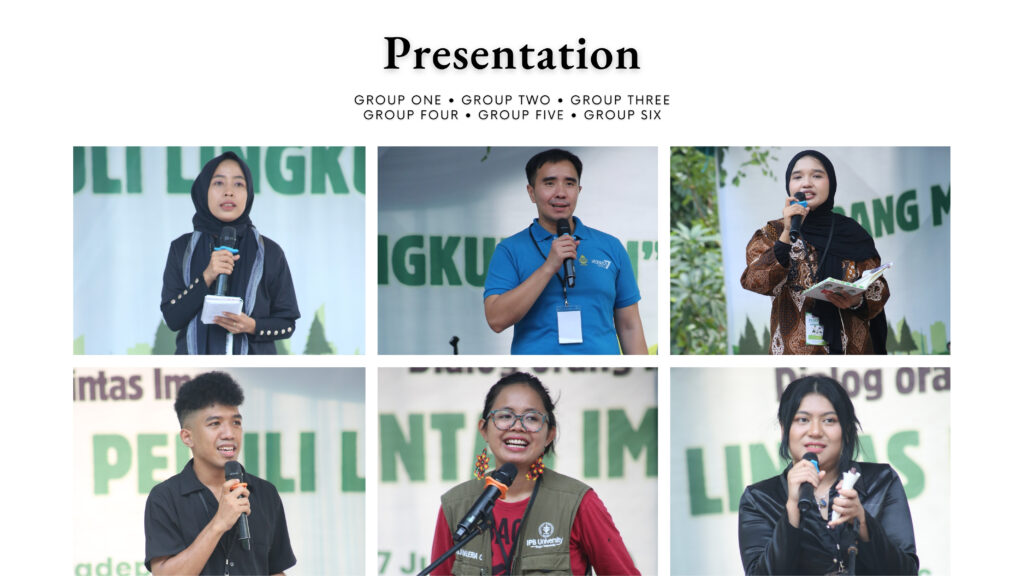
Before and after the group presentations represented by six group leaders, interspersed with displays of events prepared and presented by the Franciscan Sisters [FSGM, OSF Semarang, FCh, SFS, SFIC, and FSE].
(10) Photo and dancing together. Exactly at 17.00 the interfaith youth dialogue activity finished. Based on the series of events held from morning to evening, it is clear that interfaith youth dialogue is important for creating collaboration, building a culture of encounter, maintaining tolerance, and fostering a spirit of religious moderation. So that through meetings and dialogue, there is an exchange of ideas among young people of interfaith to unravel various environmental problems that occur today.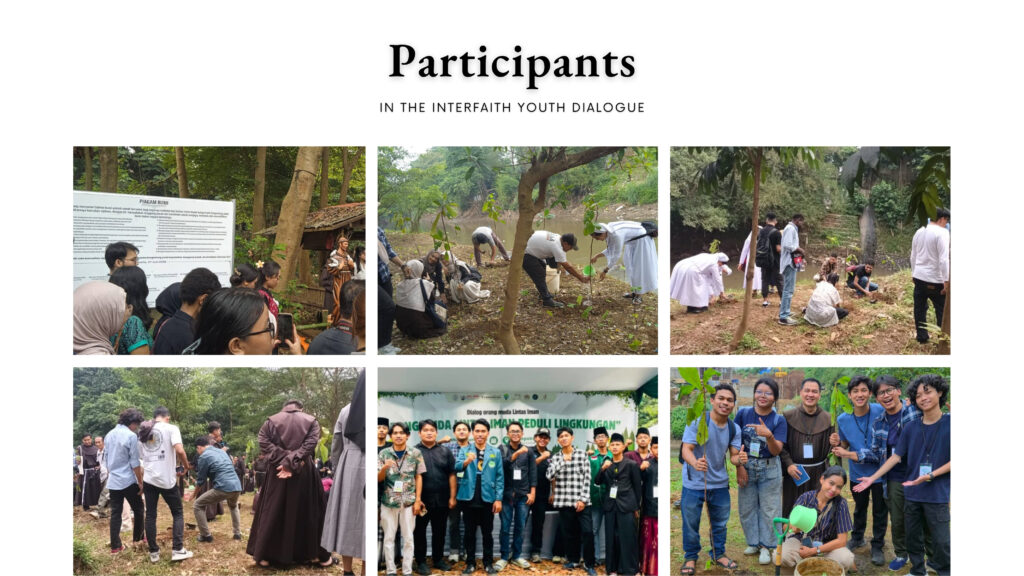
Interfaith youth dialogue activities are not merely a means of meeting and dialogue that stops at the theoretical level, but rather a space to encourage real action in response to the ecological crisis, the cries of the earth, and the cries of the poor. It is hoped that young people of different faiths can become agents of change and dare to speak critically, especially when confronted with development policies that exploit nature. This is because the exploitation of natural resources exacerbates climate disasters, pollutes ecosystems, and threatens animal habitats. Furthermore, the poor and indigenous communities are the most vulnerable groups and suffer from environmental damage and the climate crisis. It is important to recognize that as holders of the future, young people are the generation that bears the long-term consequences of environmental degradation and climate change.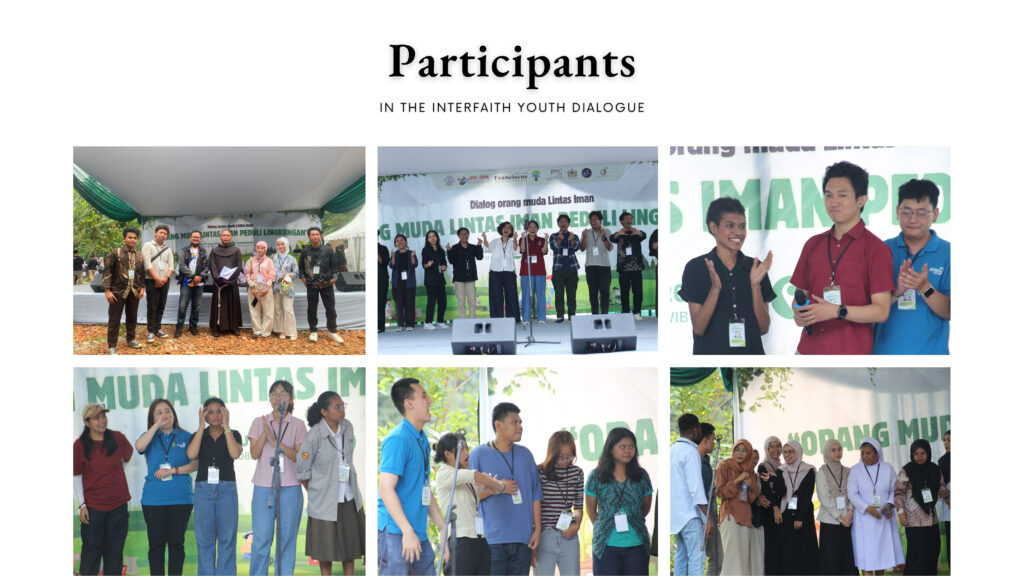
Through diligent and faithful collaboration, young people across faiths can become key drivers in addressing the environmental crisis and pioneering environmentally friendly practices and lifestyles. Young people across faiths can even be actively involved in strengthening ecological literacy and initiating ecological education—encouraging changes in people’s behavior and lifestyles to be more ecologically sound for the sake of the planet’s sustainability. Young people possess a new ecological sensitivity and a generous spirit, and some are making admirable efforts to protect the environment. It’s no surprise, then, that young people are demanding change. They wonder how anyone can claim to be building a better future without considering the environmental crisis and the plight of those excluded.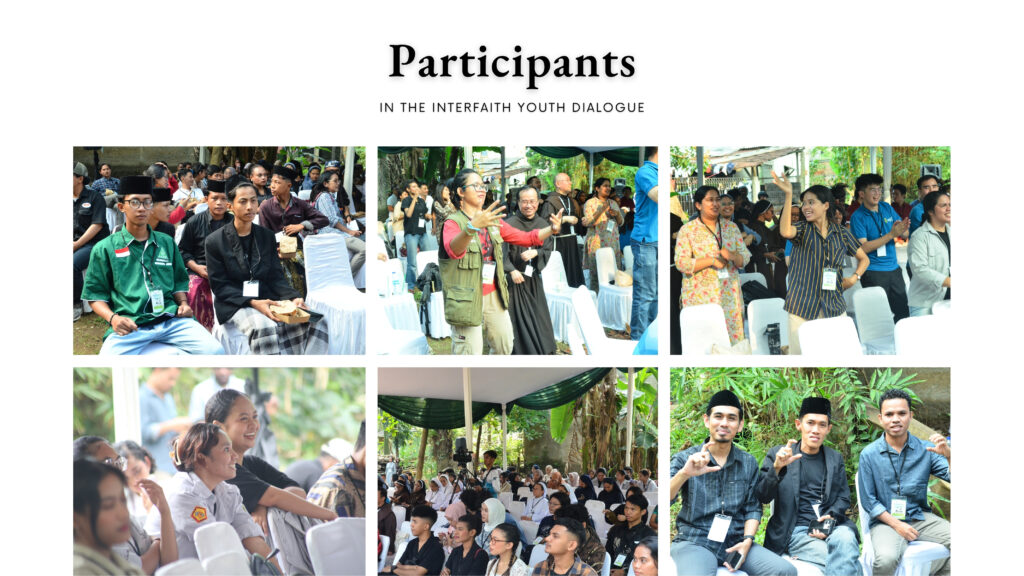
The Earth, our home, is increasingly beginning to appear as a vast garbage dump. Its resources are being plundered for the sake of short-term economics, trade, and production. This situation has left Sister Earth, along with all those abandoned by our world, crying out, pleading with us to take a different course. Furthermore, the inhabitants of this earth were not meant to live squeezed by concrete, asphalt, glass, and metal, deprived of physical contact with nature.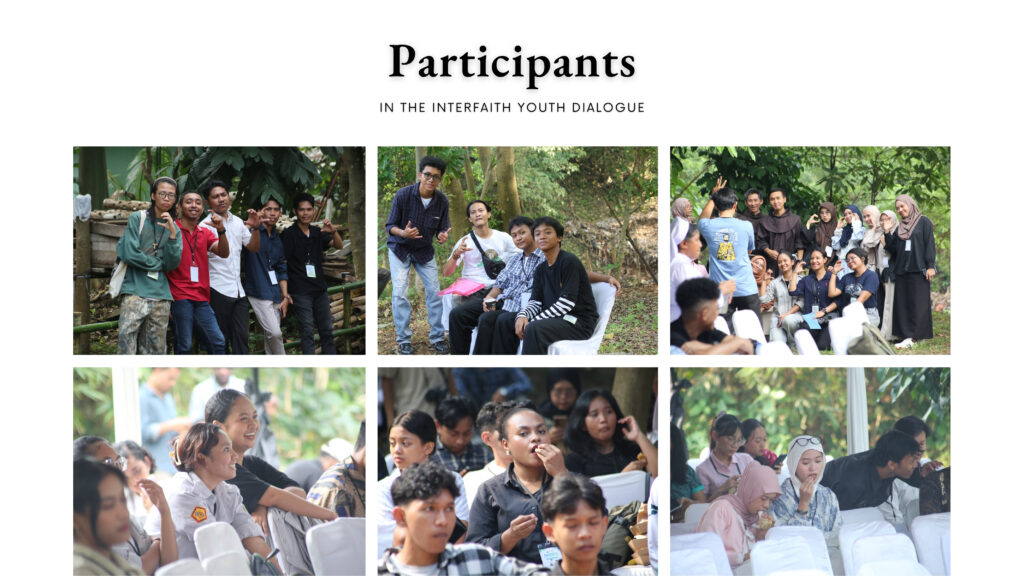
There are several objectives in interfaith youth dialogue activities. (1) Building a culture of encounter (dialogue space) among young people of different faiths. This is intended to jointly see, reflect on, and express current issues regarding the environmental crisis. (2) Discussing various ecological problems that occur today. For example, pollution and climate change, deforestation, mining, extractivism, water problems, land and air pollution, loss of biodiversity, declining quality of human life and social decline, and global inequality. (3) Growing awareness that the earth is our common home that must be loved and cared for together. The hope is that young people of different faiths can live their daily lives based on the principles of common welfare and intergenerational justice. (4) Making a shared commitment to a new lifestyle and carrying out ecological conversion.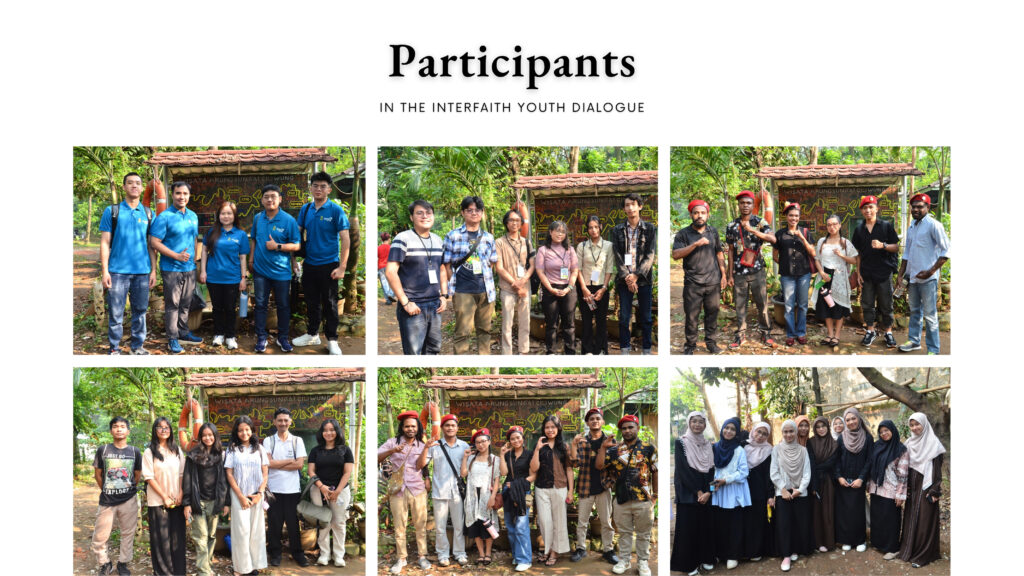
Finally, there are a number of commitments that we hope young people of different faiths will continue to strive for. (1) The environmental crisis is a global issue, and to address this issue, we are committed to working together and ensuring a sustainable environment. (2) Continuously promoting the importance of caring for the environment within the community and through social media. (3) Actively participating and contributing to various activities related to environmental crisis issues. (4) Conducting academic studies and publishing them on the environmental crisis phenomenon. (5) Providing input and evaluation to public policy makers (the government) if the policies they deliver and implement have a negative impact on the environment. (6) Being salt and light within the family, campus, religious, and community environments by setting an example of a lifestyle that loves the environment.